
Contractor Website Statistics: A Census of 939 Google Maps Profiles in Oceanside, Carlsbad, and Vista
Contractor website statistics usually come from surveys. These come from a census. We opened the website of every plumber and electrician profile Google Maps serves a homeowner searching in these three cities, all 939 of them, each on a phone.
One in four had no website linked at all. One in three had no website that worked.
The commercial reading cuts both ways. A third of the field is a dead end, which thins your competition. But merely having a website is not the finish line, because 383 of these businesses have sites that worked and looked current.
Collected July 15, 2026 · 939 businesses · 186 map coordinates · 1,116 searches · Methodology · Data (CSV)
The count
Two of these numbers required no judgment from us. 237 of 939 profiles, or 25.2%, carried no website link of any kind. Another 74, or 7.9%, linked to a site that failed when we opened it: a dead domain, a parked page, a server error that repeated on recheck. Together that is 311 businesses. 33.1% of the profiles Google Maps offered had no working website behind them.
What this means for your business
Weak competitors are only an opportunity if a homeowner can find, trust, and contact you faster than the strong ones. Four consequences fall straight out of the census.
1. A working website is the entry ticket, not the win. Of the profiles a homeowner actually meets, 383 carry a current working site, and every one of them is competing for the same call you are. Clearing the bar that one in three miss puts you in the race. Winning it is a different job.
2. Visibility and trust are separate gates, and a business can fail either one. A great website cannot rescue a company Google never shows. A visible Maps profile still loses the job when the tap behind it lands on something broken or abandoned. This census graded the second gate. Your Maps presence decides the first, before any of this applies.
3. Your competition is local, specific, and checkable. Google does not show a homeowner "North County contractors." It shows a short list of profiles near that homeowner, and the same names keep coming back. Which names Google puts beside yours is a fact someone can look up, and we did, 1,116 times.
4. This path is the work we actually do. RSP inspects the whole route a job travels: the local search, the Maps profile, the website, the call or form, the follow-up. The weakest stage caps everything upstream of it, so finding that stage comes before fixing anything.
You don't need to beat every contractor in North County
You need to outperform the handful Google repeatedly places beside you. We map those businesses, compare their visibility and trust signals against yours, and show you the first fix most likely to improve your position.
See the contractors Google puts beside you
Review the free Lead Leak Map method. The dedicated request path is pending.
What this can't tell you
- This measures Google Maps, not the market. A contractor who never appears on Maps never enters this data. We counted what a searching customer is handed, not who exists.
- Maps does not return identical results twice. We ran the full collection two times on the same day. The first pass found 922 businesses; the second found 939. Every figure here carries that run-to-run variation, so the decimal place is not load-bearing.
- Nothing here is about revenue, leads, or rankings. We measured websites.
- Nothing here is about licensing. We attempted to match profiles to state license records and the match rate was too weak to support any claim.
- Three cities, not a region. Oceanside, Carlsbad, and Vista. The numbers do not travel beyond them.
- No business is named. The public dataset is aggregate only.
How the count was built
Google Maps answers according to where you stand. Search "plumber" from the harbor and you get one list; search it again from the mission and you get another. A single check from a single spot says almost nothing about a city, which is the quiet flaw in most local business surveys.
So we didn't search once. We fixed 186 coordinates in a 2-kilometer grid across the three cities and ran the search from every one of them, three ways each: plumber, plumber near me, emergency plumber, and the electrician equivalents. 1,116 searches total. Every one completed.

Deduplication used Google's own place identifier. Names were never compared, so two similar names stay two businesses and one business that surfaces in forty different searches still counts once. A real Chrome browser, set to the screen size of a phone, then opened every linked website and logged what came back.
The rules were locked first
The grid, the queries, the grading rules, and the publication conditions were written and version-controlled before the first search ran. One condition was a stop rule: if more than 20% of businesses could not be graded confidently, no percentage would be published. This run came in at 7.5%. The full protocol ships with the dataset, and the methodology page has the short version.
Plumber and electrician website statistics, city by city
Split the data by city and trade and you get six views of it. They agree. The share of profiles with no working website runs from 28.0% at best to 37.4% at worst.
Inside that consistency, one clean split. Electricians trail plumbers in every single city: 37.4% of Oceanside's electricians have no working website against 32.4% of its plumbers, 36.6% against 31.1% in Carlsbad, and 33.6% against 28.0% in Vista. We don't know why, because the data doesn't say. But it held everywhere we looked.
The stricter cut: 51.8%
The numbers above required no judgment. This one requires ours, so it is labeled.
Beyond the 311 businesses with no working site, another 175 linked to a website that fails RSP's published grading standard: it doesn't fit a phone screen, doesn't load over HTTPS, or shows at least two staleness signals such as a copyright line three or more years old. Add those and 486 of 939, or 51.8%, fail. That figure depends on where we drew the "outdated" line. The rules are published, and anyone can re-draw the line with the data and see what moves. If you quote one number from this page, quote 33.1%.
The failed pilot
Our first attempt started from the state contractor license register and tried to find each license holder's website. It hit 58% ungraded. The stop rule fired and we discarded it.
The autopsy taught us more than the study would have. License names are often not the names businesses trade under, and a license register turns out not to be a list of operating businesses at all: it holds dormant licenses and subcontractors who never meet a homeowner. Counting who a customer is actually shown removed the problem that counting license holders could only manage. The failed pilot and its 58% ungraded result are preserved with the research record.
Use the data
The aggregate dataset is a free CSV download: all six city-trade groups, every classification, counts and shares. The methodology page covers the grid, the grading rules, and what was deliberately left out. Reporters and researchers who want more can request the full package: the pre-registered protocol, the per-search log, and the coordinates to re-run the whole study. No business is named in any of it.
Media kit
Charts and graphics are free to reuse with attribution (CC BY 4.0).
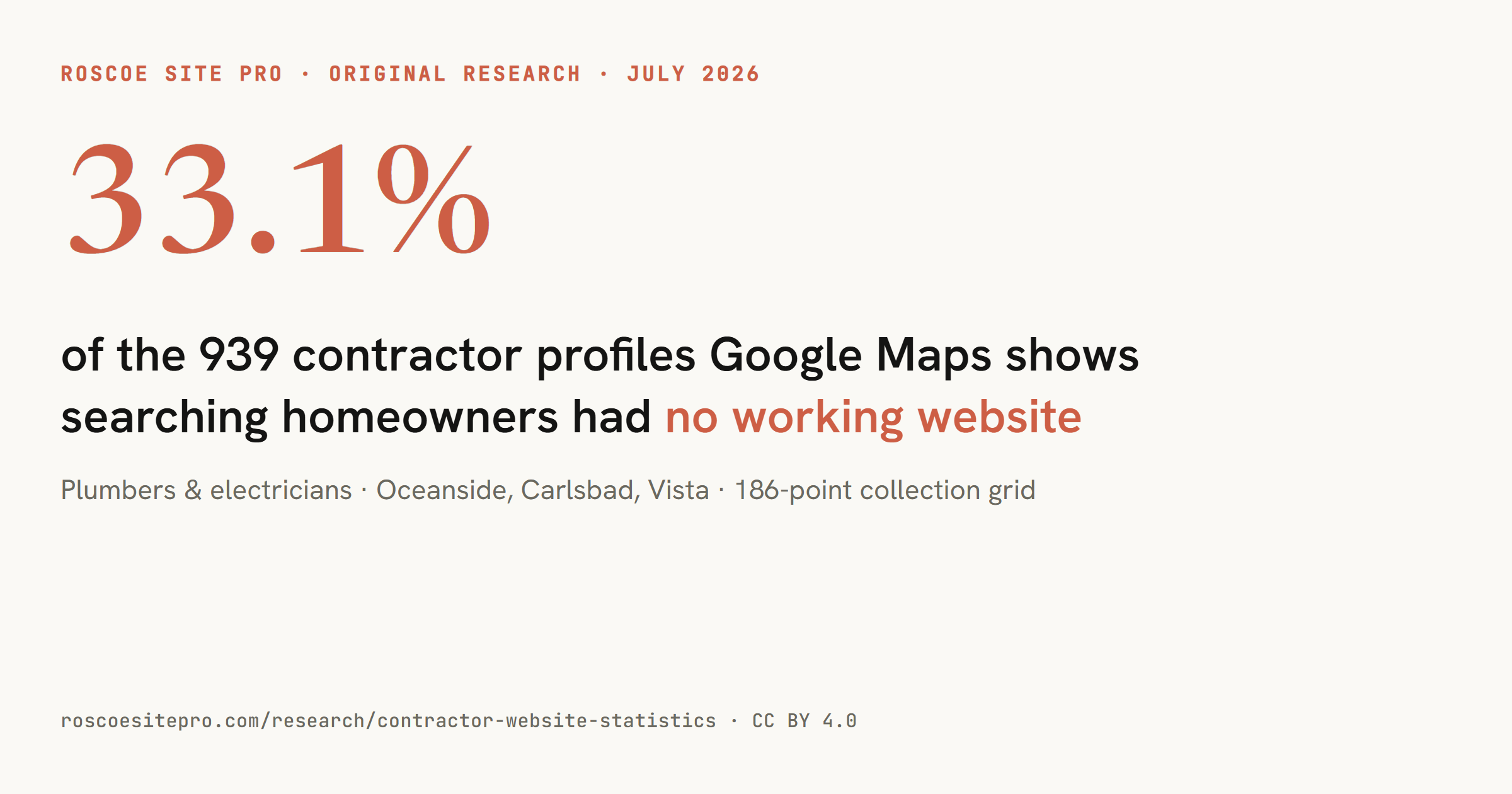 Headline graphic (1200×630 PNG)
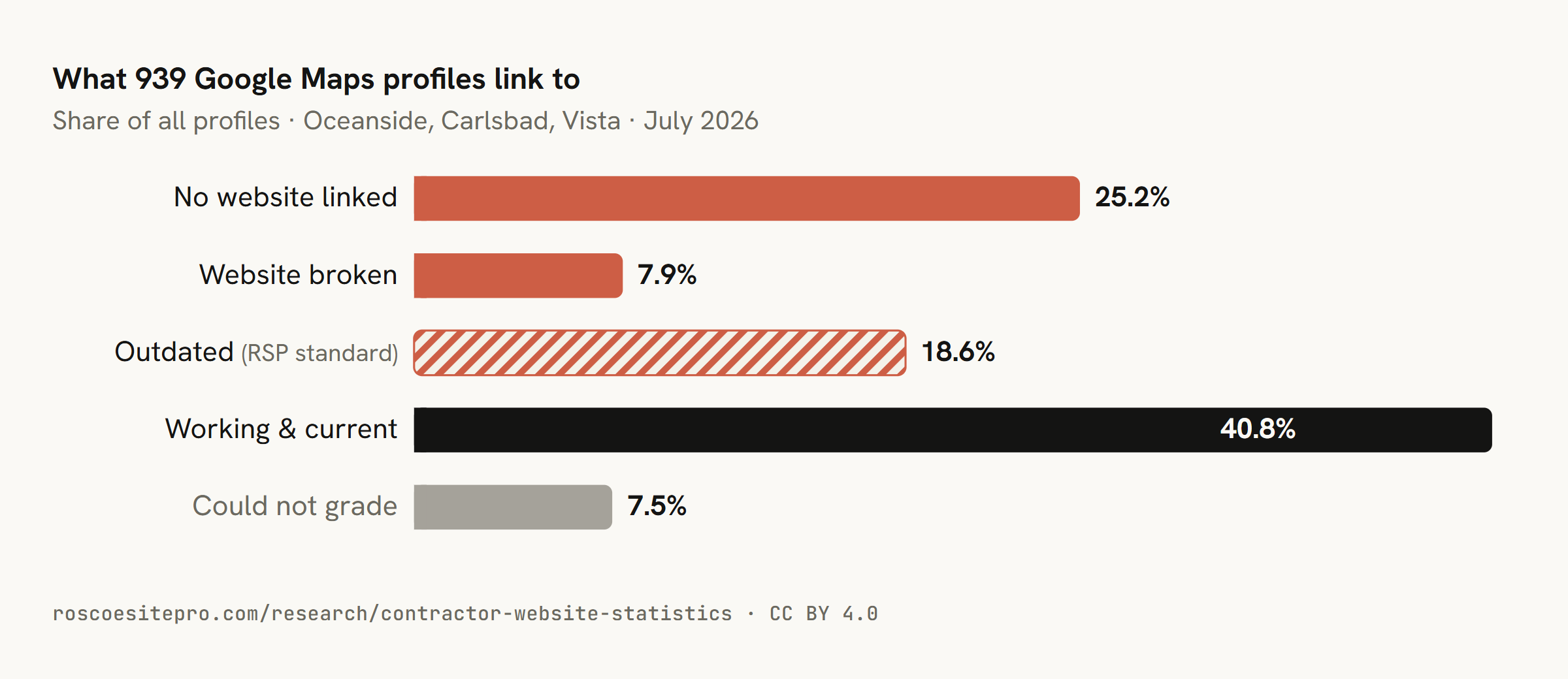 Classification chart (PNG)
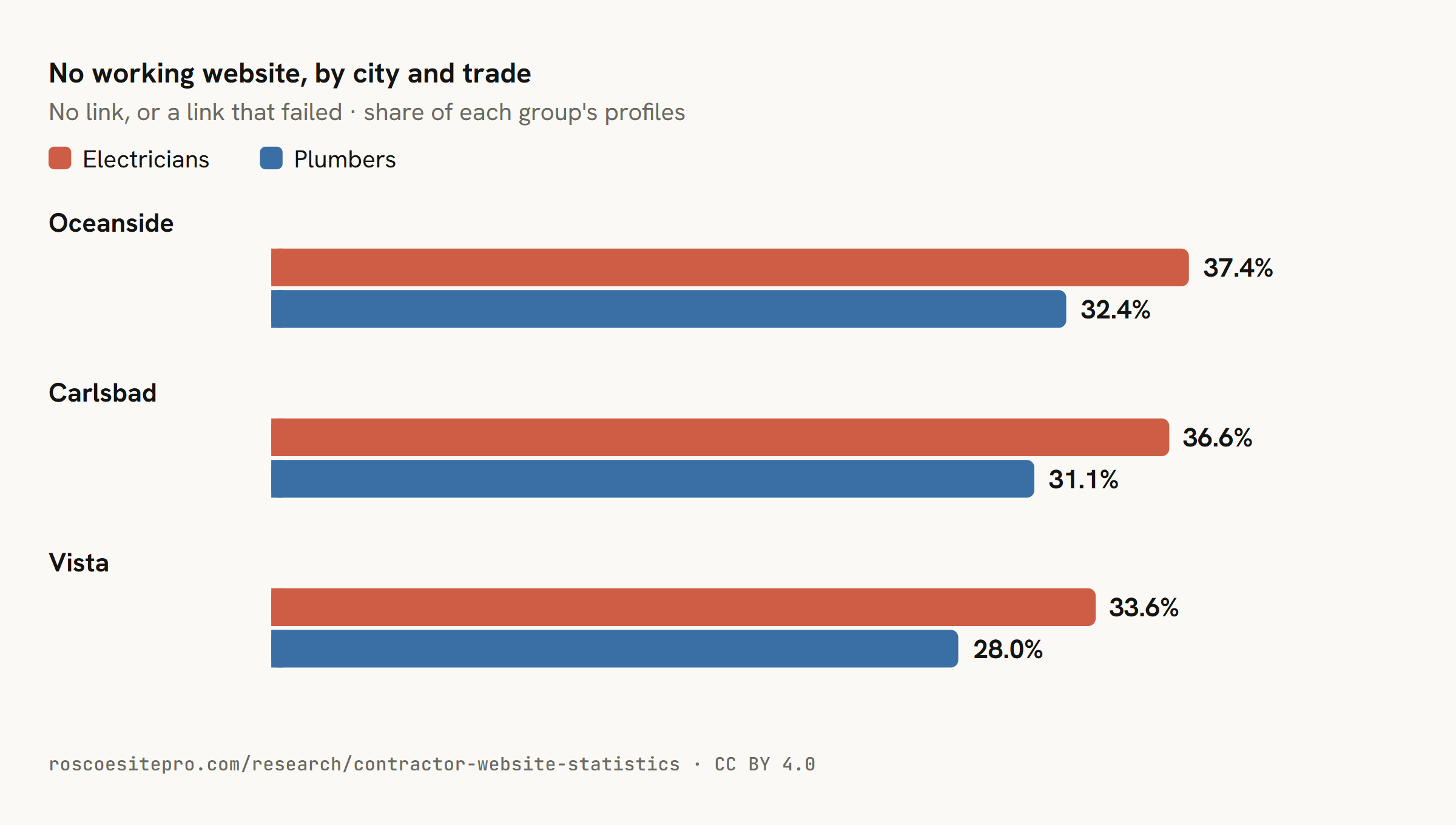 City & trade comparison (PNG)
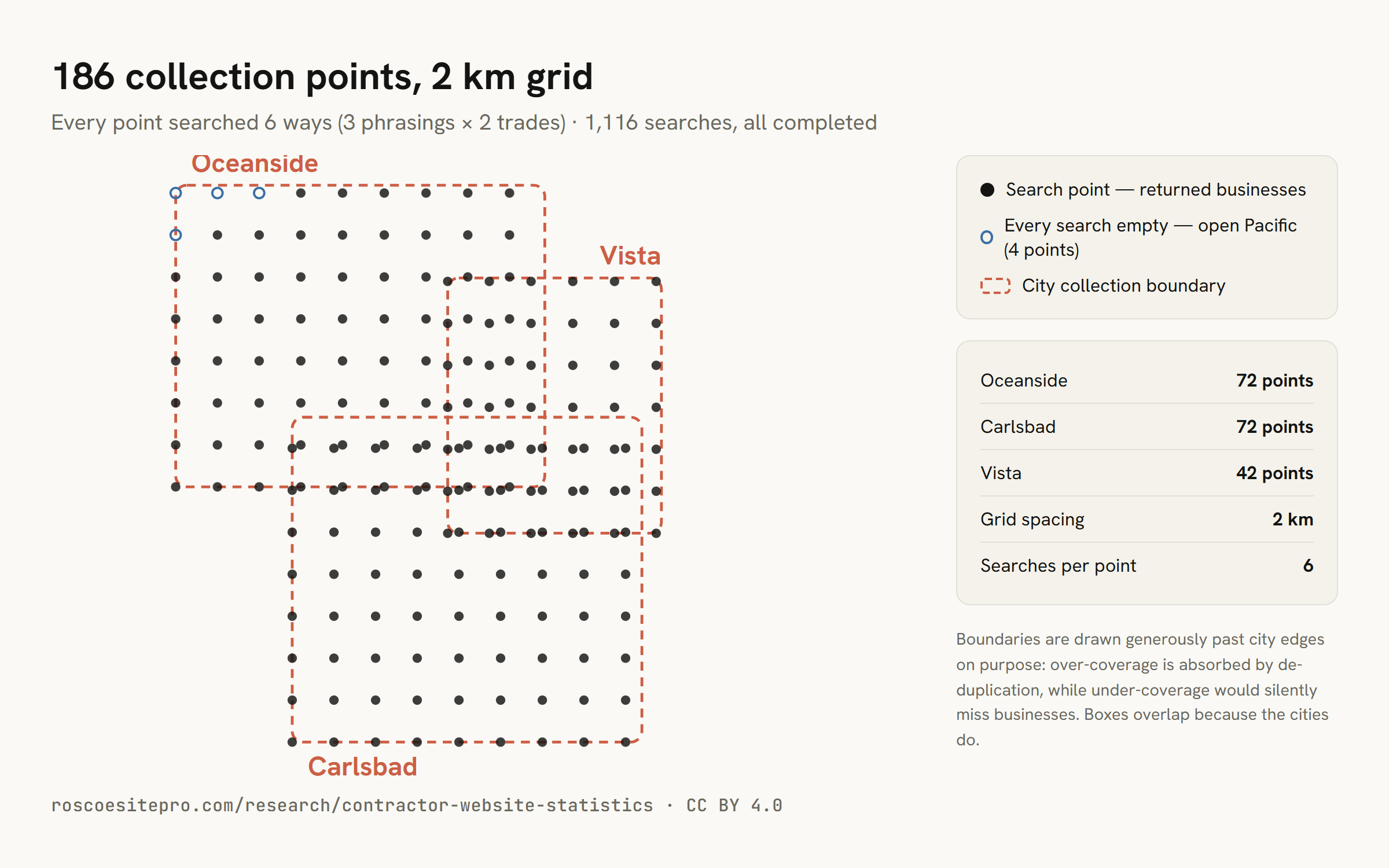 One search vs. the census (PNG)
How to cite this research
Roscoe Site Pro (2026). Contractor Website Statistics: A Census of 939
Google Maps Profiles in Oceanside, Carlsbad, and Vista. Collected July 15, 2026.
https://roscoesitepro.com/research/contractor-website-statistics
Figures, charts, and the dataset are licensed CC BY 4.0. Quote 33.1% freely. If you use the 51.8% figure, please note that it reflects RSP's published grading standard rather than an availability check.
Disclosure: Roscoe Site Pro sells website and local-visibility services to contractors, including in these three cities. The methodology, grading rules, aggregate data, and failed pilot are published so the result can be independently evaluated.
If you're a contractor in one of these cities, one in three of your competitors on the map has no working website behind their listing. Whether you're one of them takes about a minute to check. A free Lead Leak Map shows you what a searching homeowner actually sees.