
Google Maps contractor visibility study: 40,773 profile appearances across 1,116 searches
Google Maps contractor visibility study: we searched for plumbers and electricians from 186 fixed locations across Oceanside, Carlsbad and Vista, three phrasings at every point, and preserved all 1,116 responses.
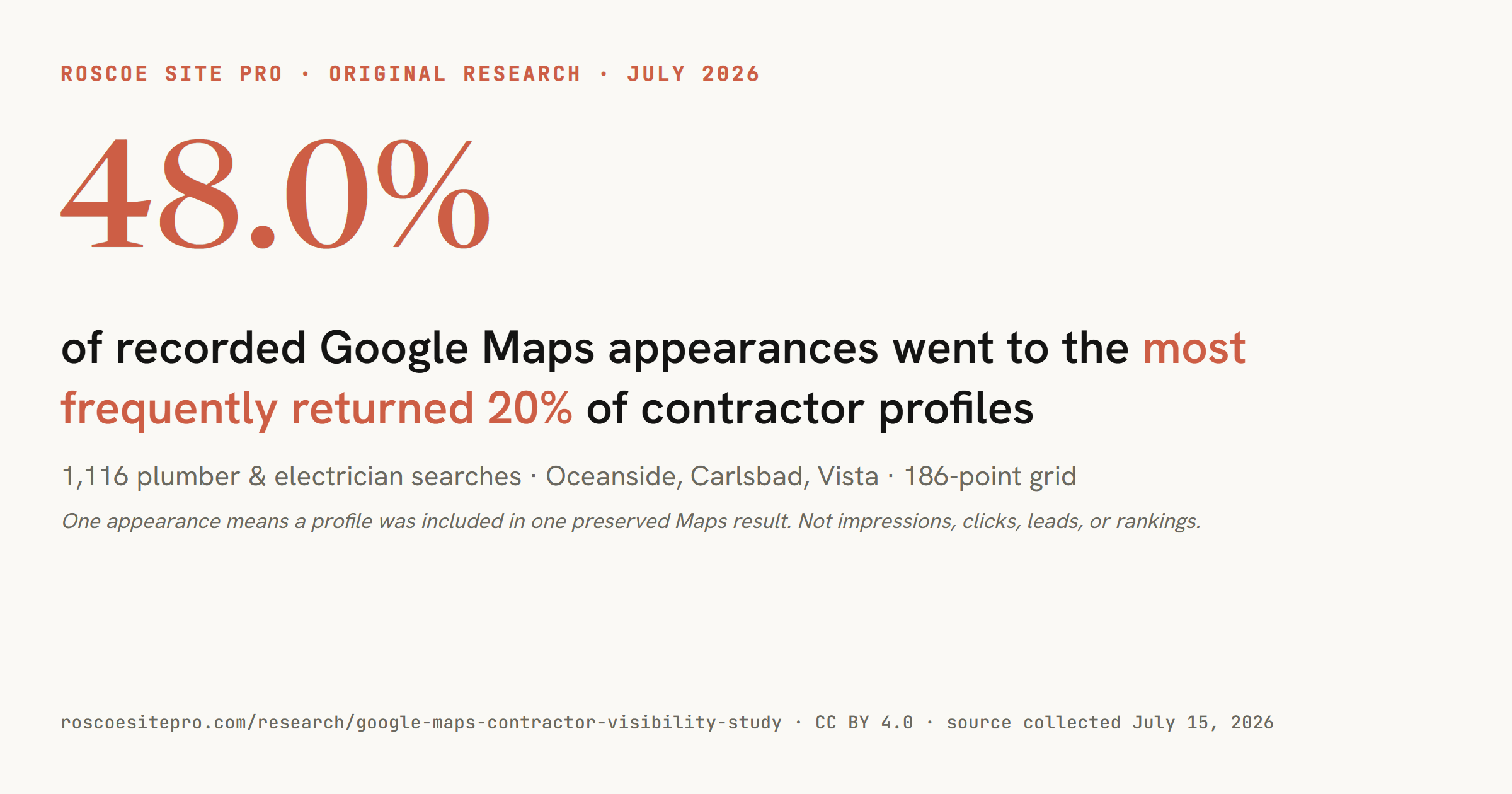
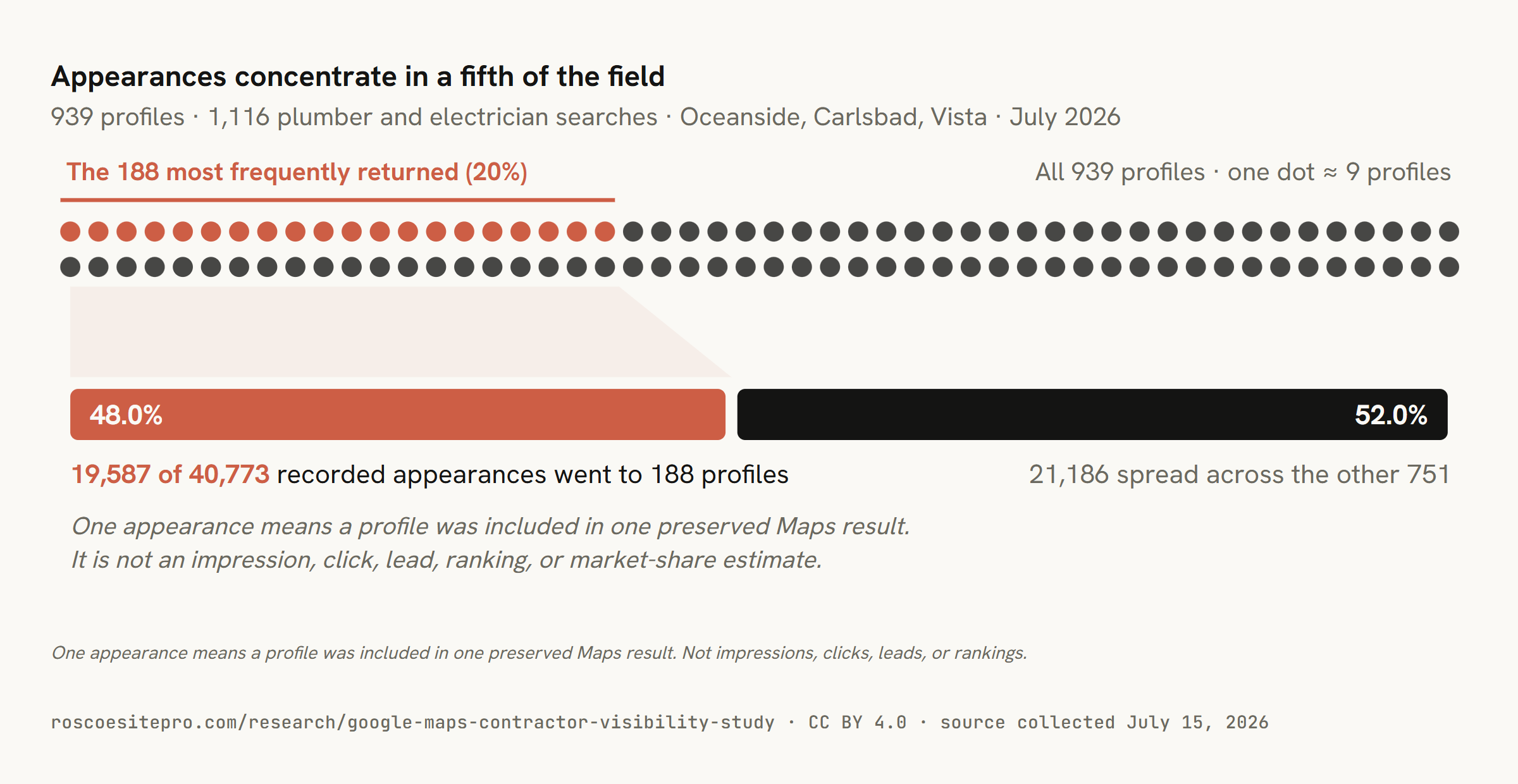
The count leans hard. The most frequently returned 20% of profiles accounted for 48.0% of the 40,773 recorded appearances. That is the same fifth of businesses surfacing over and over, together holding close to half of the recorded appearances across the three cities.
One appearance means a profile was included in one preserved Maps result. It is not an impression, click, lead, ranking, or market-share estimate.
Source collected July 15, 2026 · Analysis July 17, 2026 · 939 profiles · 1,116 searches · Methodology · Data (CSV)
One search is not your market
Move two kilometres and roughly one-third to one-half of the returned field can change. Add “emergency” and it can change again. We map the locations and phrasings that matter to your business, identify the profiles Google repeatedly places beside you, and show you which gate to inspect first.
Map the contractors Google puts beside you
Get your free Contractor Lead Leak Map. Grounded in your real data, no signup form.
What we measured
Two studies now come out of the same collection. The first, our contractor website census, asked what the 939 returned profiles link to. This one asks the question underneath it: before a profile's website even matters, how often does Google return the profile at all?
The unit is deliberately narrow. Every time a preserved search result included a profile, that profile earned one appearance, and a profile could earn at most one appearance per search. Nothing in the data says why Google returned a profile, and we do not guess. What it records is the discovery surface itself: which business profiles the searches returned, again and again, across a whole service area.
The concentration finding
The spread is steep. The typical profile appeared in 38 of the 1,116 preserved searches. One profile in ten appeared exactly once. At the other end, the most frequently returned profile appeared 252 times across overlapping city scopes. Stack the shares and the shape is plain: the most frequently returned 1% of profiles drew 5.2% of recorded appearances, the top 5% drew 16.8%, the top 10% drew 28.7%, and the top 20% drew 48.0%.
It is not a quirk of one city or one trade. Cut the data into its six city and trade groups, and in every one the most frequently returned 20% drew between 38.6% and 53.9% of that group's appearances.
| Group | Profiles | Appearances | Top 10% share | Top 20% share |
|---|---|---|---|---|
| Oceanside electricians | 257 | 6,537 | 22.7% | 39.6% |
| Oceanside plumbers | 339 | 7,794 | 28.8% | 50.3% |
| Carlsbad electricians | 306 | 7,800 | 22.1% | 38.6% |
| Carlsbad plumbers | 389 | 7,363 | 28.8% | 49.4% |
| Vista electricians | 283 | 5,376 | 26.3% | 45.6% |
| Vista plumbers | 389 | 5,903 | 32.5% | 53.9% |
City groups overlap by design, because one business can legitimately be returned to searchers in more than one city. The six rows are six views of one collection, not six separate markets, and their profile counts cannot be summed.
Why query phrasing matters
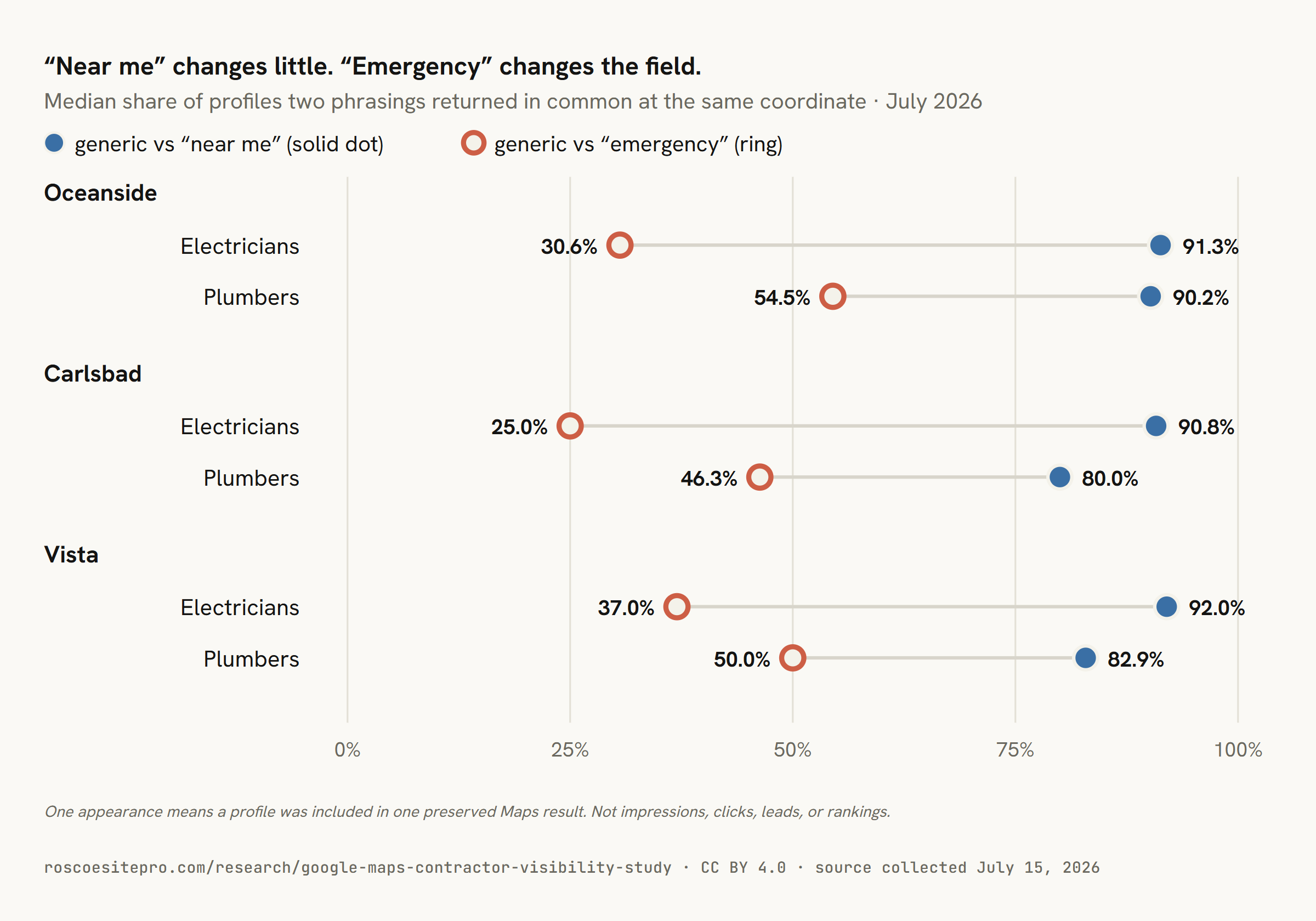
Stand on one spot and search “plumber,” then search “plumber near me.” Google treats them as the same question. Across the six city and trade groups the two returned largely the same profiles, with median overlaps of 80.0% to 92.0%. Now add a single word. Search “emergency plumber” and the field reshuffles, with median overlap against the plain query dropping to somewhere between 25.0% and 54.5%.
Neither phrasing is “better,” and overlap says nothing about which businesses deserve to be returned. It just means a single keyword never covers the whole discovery surface. Check your visibility with one phrasing and you have seen one slice of it, and the urgent-intent slice, the one that fires when a pipe bursts at midnight, can look nothing like the rest.
Why one location is not a city
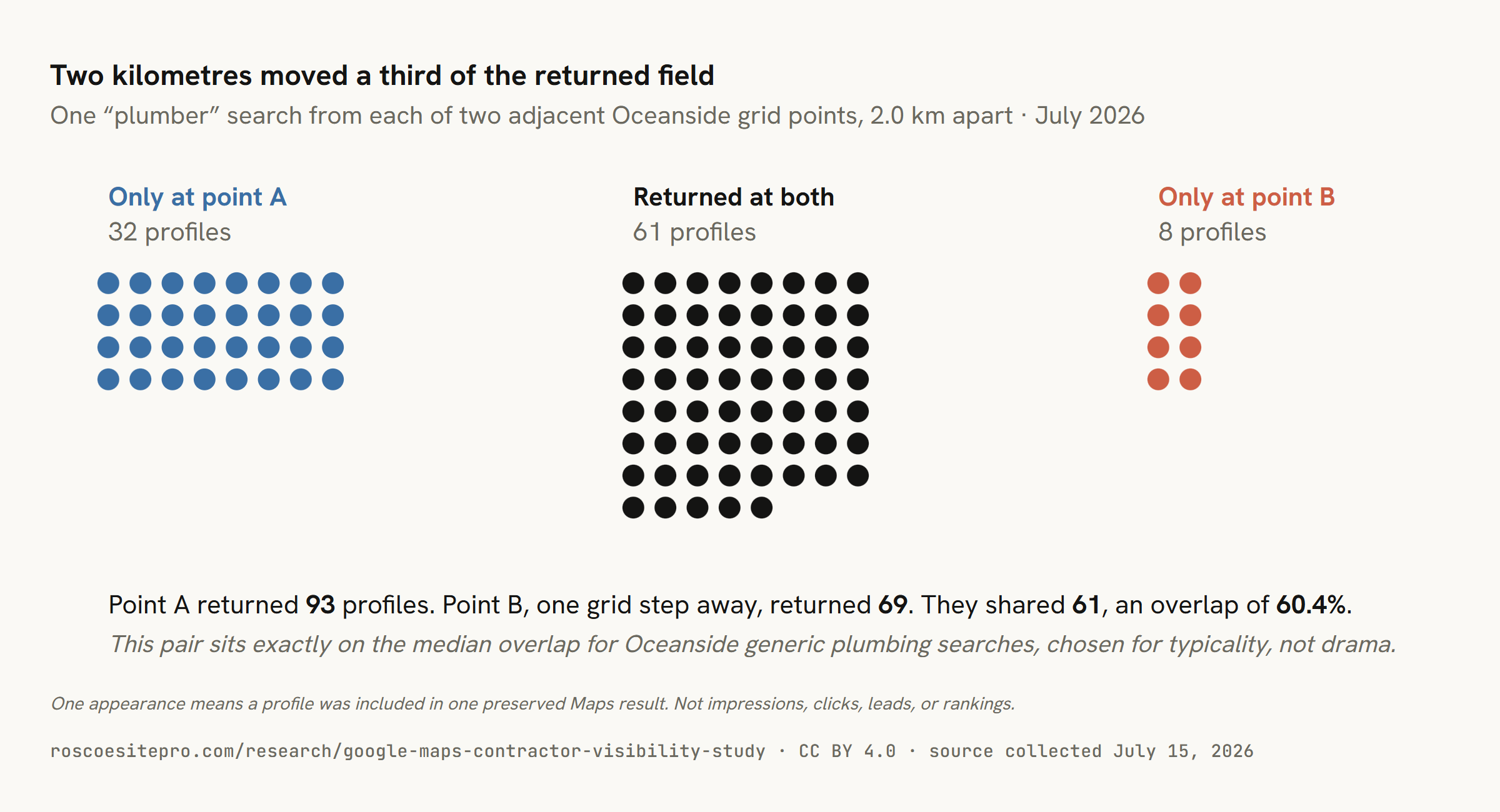
Google Maps answers from where you stand. For identical phrasing on the same day, grid points roughly two kilometres apart shared a median of 52.4% to 64.4% of their returned profiles, depending on the city, trade, and phrasing. Half to two-thirds of the field persisted between neighbouring points. The rest changed.
A spot check from one office, one home, or one ZIP-code centroid cannot describe a service area, because the field it sees is partly an accident of where you happened to stand. Any visibility claim built on one search inherits that accident.
What contractors can do with this
Return frequency is measurable. Once you measure it, the useful question is no longer “am I on Google?” but a sharper sequence:
- Map the service area at multiple coordinates, not from the shop.
- Use the phrasings customers actually type, including urgent-intent variants where they fit the trade.
- Identify which profiles Google repeatedly returns beside yours. That short recurring list is the field you are actually measured against.
- Diagnose visibility separately from website trust and lead response. They are different gates, and a business can fail any one of them.
- Fix the first weak gate. One screenshot cannot tell you which gate that is.
That sequence is a process, and it is the process behind our Contractor Lead Leak Map. It promises measurement, not movement: no ranking, call volume, or revenue outcome is implied anywhere in this study.
What this study cannot tell you
- It measures Google Maps, not the contractor market. A business that never surfaces in these results is not necessarily absent from Google Maps, and the Maps surface is not the market.
- It cannot say why. The most frequently returned plumbing profiles do carry more reviews (medians of 22 against 14 in Oceanside, 43 against 15 in Carlsbad, 40 against 19 in Vista), but the electrician groups are mixed, and observational data cannot establish what causes return frequency. Reviews and website status are overlays here, not explanations.
- Nothing here is an impression, click, call, lead, job, ranking, or market share. We counted inclusions in preserved results.
- Maps is nondeterministic and point-in-time. Return frequency is conditional on this grid, this query set, this date, this zoom, and this endpoint. The searches ran through DataForSEO, a high-fidelity proxy for a Maps result rather than a human session.
- Three cities and two trades are not all of North County. The numbers do not travel beyond Oceanside, Carlsbad, and Vista, or beyond plumbers and electricians.
- No business is named. The public data is aggregate only. The frequency groups rank nothing and judge nothing, because “most frequently returned” is a count and not an award.
Method and duplicate normalization
The collection is the census grid: 186 coordinates spaced two kilometres apart across the three cities, each searched six ways (plumber, plumber near me, emergency plumber, and the electrician equivalents), 1,116 requests, every one completed and preserved on July 15, 2026. Deduplication uses Google's own place identifier, so a business that surfaces in forty searches counts forty appearances but only ever one profile.

One honesty note before the arithmetic. This analysis was chosen after the collection already existed, so its headline values were visible in exploratory form before the study was framed. The protocol records those values, and every definition, cut, gate, and prohibited claim was frozen in writing before the production analysis ran. An independent script then rebuilt every headline number from the raw responses and matched.
The raw responses hold 40,774 profile entries. One Vista plumbing response listed the same profile identifier twice. A profile can contribute at most one appearance per search, so that row was deduplicated and every figure on this page runs on 40,773 normalized appearances. The affected row is logged in the study record. No other response contained a duplicate.
Download the aggregate data
Four CSVs cover everything on this page, free to reuse with attribution (CC BY 4.0). No business-level records are included in any of them.
- Concentration by percentile and group: profiles, appearances, and captured shares for the top 1/5/10/20%.
- Query-phrasing overlap: median and quartile overlap for every phrasing pair, by city and trade.
- Adjacent-point overlap: median and quartile overlap between neighbouring grid points.
- Frequency-tier overlays: descriptive review and website-status medians by tier. Overlays, not explanations.
Reporters and researchers who want more can request the full package: the frozen protocol, the independent verification script, and the per-search log. No business is named in any public file.
Media kit
Charts and graphics are free to reuse with attribution (CC BY 4.0). Each carries its source, collection date, and the appearance definition.
 Headline graphic (1200×630 PNG)
 Concentration diagram (PNG)
 Query-phrasing chart (PNG)
 Adjacent-points diagram (PNG)
How to cite this research
Roscoe Site Pro (2026). Google Maps Visibility for Local Contractors:
40,773 Profile Appearances Across 1,116 Searches in Oceanside, Carlsbad,
and Vista. Source collected July 15, 2026; analysis July 17, 2026.
https://roscoesitepro.com/research/google-maps-contractor-visibility-study
Figures, charts, and the dataset are licensed CC BY 4.0. If you quote the concentration finding, please keep the definition beside it: one appearance means a profile was included in one preserved Maps result, not an impression, click, lead, ranking, or market-share estimate.
If you're a contractor in one of these cities, the field Google actually shows searchers near you is measurable, and it is probably not what one search from your shop suggests. A free Contractor Lead Leak Map measures it for your actual service area.